Critical Reflection
Critical Reflection
Keywords:
Transcension
Personal Mythology
Repression
Core Theme and Intention
My philosophy is that the conquering of repression triumphs over all human achievement. World peace can be made when we can find it in ourselves to release that repression from time to time. This is closely related to the Terror Management Theory that I hold dear to my heart. “Human culture and self-esteem function as buffers against the terror of mortality, allowing people to deny or transcend the fear of death.” — Sheldon Solomon, Jeff Greenberg, and Tom Pyszczynski, The Worm at the Core: On the Role of Death in Life (2015). How cool is that, to blame everything that we have ever built on a desperate attempt to transcend death. How can I not talk about this, how can anyone not think about this daily.
This fascination with repression came from me being bed-bound for an extended period when I was a small child. It fascinated me, the why and how of fear. This feeling called fear is so primal that we revert to savages when it controls us. That made me dig deeper into the philosophy of fear. That search led me through religion, philosophy, myths, and legends. The Denial of Death by Ernest Becker was a great influence. “The idea of death, the fear of it, haunts the human animal like nothing else; it is a mainspring of human activity — activity designed largely to avoid the fatality of death, to overcome it by denying in some way that it is the final destiny for man.” — Ernest Becker, The Denial of Death (1973). It guided me toward repression, the main defence mechanism we have for the monster hiding under our bed. “The skull will grin in at the banquet. The worm is at the core of everything.” — William James, The Varieties of Religious Experience (1902). It is the best way to describe fear. However thick our layers of repression are, there will always be a worm gnawing at you from the core. The best way is to recognise this worm and show it to the world whenever possible.
My work has changed throughout this year, from the drive to express my own fear through etching to the active rebellion against the mythical battle of repression in my mind. The transition has been a surprise. I feel like I have a purpose with my work, acting as propaganda, to call for arms to everyone who looks at it, to awaken that consciousness in their mind. They should be the ones peeling off those layers of repression, to stop holding too tightly to control.
Printmaking is my favourite medium, no doubt about it. In printmaking, we reduce, we take away layers and layers of metal or wood to reveal the truth underneath. This truth is not discovered by me alone, but the plate acts as a collaborator along the way. It tells me when to add or when to reduce. Every time I print, it is a practice of letting go, to understand that fear does not bind you, that letting go is the best way to gain control of your life. Printmaking helped me understand that.
I want people to feel rejuvenated, to confront that worm in the back of their head. It might be small and fragile, but the power that worm has on me has shaped the decisions of my life. It will always be there, and it is up to you to take it into account when making your own choices. I don’t expect my work to say all this outright; it would be foolish to decide for the audience what the image means. The most I can do is intrigue you, make you feel something, and if you are truly interested, pull you into my artist statement. That is all an artist can do. To be honest, I could die happy knowing my work stirs something in people.
Worm at our core, Boris Kwok,2024,Etching
My Process and Materials
In printmaking, I am always driving this car blindfolded. I carry my stubbornness, my fear, and my pride in prints. Each step of the way, I try my best to express what is uniquely me. The act of making prints and casting requires pressure. These pressures press my artwork into being. I imagine them as branding on an animal; the paper or plaster is an extension of my skin. I am pressing them into existence, forcing them outward for the world to see.
Working with Jesmonite and three-dimensional objects deepened my understanding of this pressing philosophy. The plaster fills every line and space unconditionally, then picks up all the details. The way it turns from a liquid form into a solid mirrors layers of skin, from the soft and vulnerable core to the hardened surface that protects it. It is the perfect reflection of how repression grows, from our fragile beginnings into tougher exteriors as we experience more of the world. As Ernest Becker wrote, “To live fully is to live with an awareness of the rumble of terror that underlies everything.” (The Denial of Death, 1973).
When the plaster dries, the inked carborundum areas look like healed scars, reinforcing the idea that childhood trauma can become the foundation of repression. Søren Kierkegaard wrote, “Anxiety is the dizziness of freedom.” (Fear and Trembling, 1843). I see that dizziness in my work, the tension between fear and the will to move forward.
My drawings on the plaster armor were crude. I reverted to my illustration roots when sketching them, and I am not too proud of that. But the water-based Caligo ink saved the day. To make plaster catch ink, I must use water-based ink. The bleeding that follows is a happy accident, allowing the image to remain simple yet distorted. It turned out better than I expected. It pulls the viewer into the world of the armor, asking them to contemplate the story behind it. It would not have been as successful if it were a clean, direct translation from plate to plaster.
In spirit ground, I found the face of my adversary. I have always felt strange giving repression a physical form. It is not simply a monster that can be slain or conquered. It is something that demands understanding and compassion before it can dissolve. Spirit Aquatint came to me by accident. I still do not know if I am doing it correctly. That accident helped shape my vision of repression. The uncontrollable, worm-like texture fits perfectly with this villain in my story. It looks like a Rorschach test; show it to different people, and each will see something else. It gave me a new understanding of repression, not as a single being, but as the air we breathe and the sky we look up to.
Martyr’s Carapace
Work Analysis
Historically, armor was made for protection, a way to resist physical damage. Over time, that history also romanticised armor as a mental shield, a kind of moral clothing. You see it in the Christian idea of the armor of God, a metaphor for inner protection and resolve. You also see it in psychology, where Wilhelm Reich describes character armor as the body and mind tightening to defend against fear and feeling. In courts and on battlefields, armor was never just practical gear. “Put on the full armor of God, so that you can take your stand in the day of evil.” — Ephesians 6:11. Armor communicated identity and status. It was propaganda worn on the body.
I feel like I was too shallow in thinking about armor. Armor as protection can mean many things: a hard hat on a building site, or the apron and gloves we wear for etching. These are modern forms of armor that save us from harm or death. I want to push this further and think about what armor looks like today, not just in medieval stories but in studios, hospitals, and streets.
The theme shifted as I worked. At the start, I imagined armor I could wear to fight my private battle with repression. I had the mace from Unit 2 and a suit for the war ahead. The more I thought about it, the more I felt the contradiction. “Armoring is the condition that results when energy is bound by muscular contraction and does not flow through the body.” — Wilhelm Reich. I am not here to tell people to wear more armor than they already do. I want us to shed it, to be emotionally naked with the world and with each other.
That change turned the suit into a relic rather than a uniform. Not gear for the next fight, but a leftover from a battle already finished. In a peaceful time, when release has replaced rage, someone might dig up this armor and ask how hate ever needed such heavy tools. The museum frames shift the message from me to us. Armor becomes a memory object, a warning, and a mirror. Courts once used armor to stage power, and that same performative charge can be flipped in a gallery to ask viewers not to repeat the script.
Martyr’s Carapace, 190x80x40cm, Plaster, Boris Kwok, 2025
Swinging
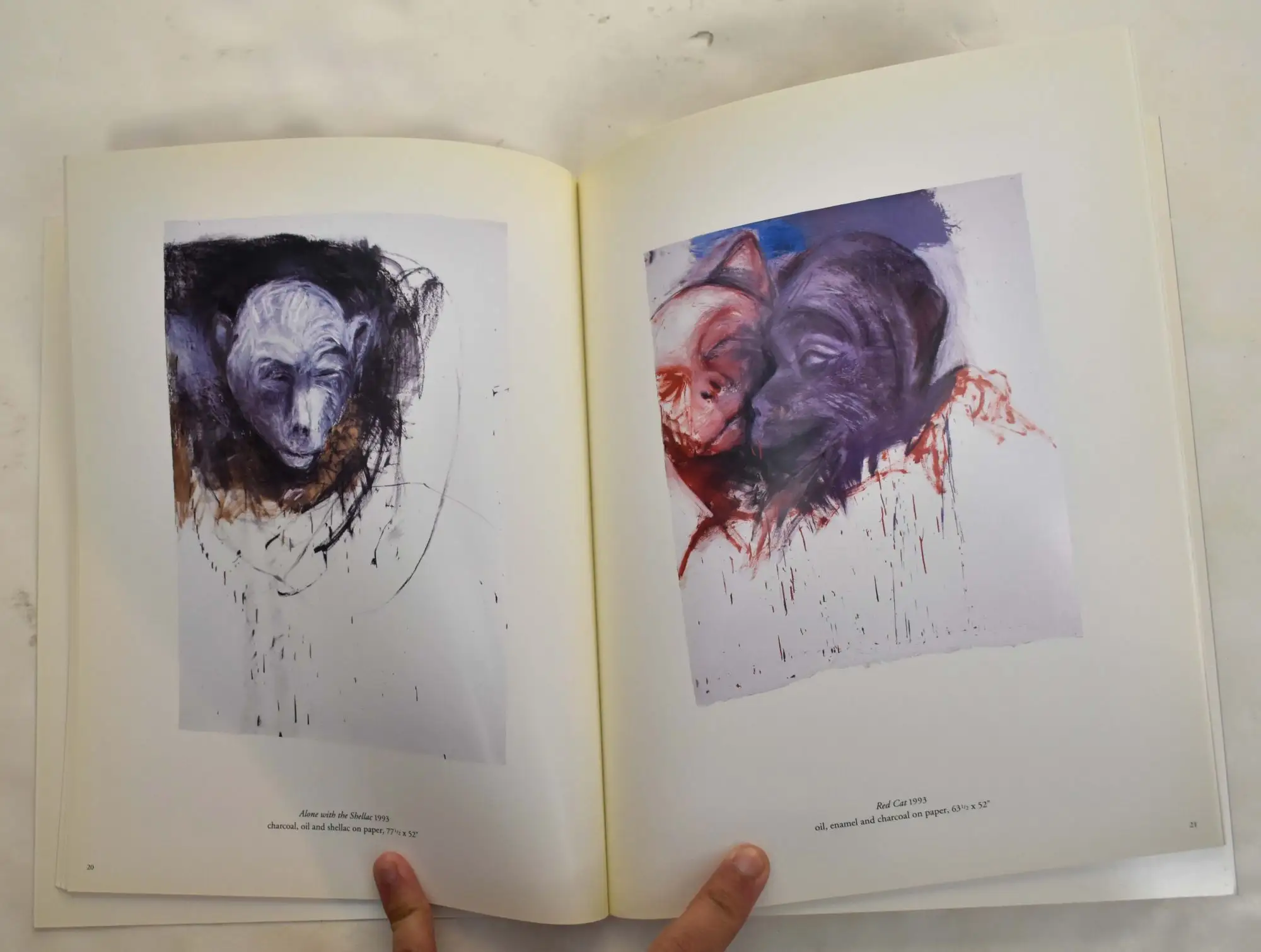
This is a very chaotic print. I did not like it until I added the last layer of hardground. It is my perseverance through this work that I am most proud of. I was inspired by Jim Dine’s Cat and Ape drawings, especially Alone with the Shills and Red Cat. They exist in a constant state of exhaustion and love. The intimacy feels forced, full of regret, or maybe it is just two animals sharing a quiet moment together. The ambiguity of these animal faces gives more than human faces ever could. As viewers, we project our own emotions onto them, filling in what we think they feel.
I wanted the faces in Swinging to have that same effect. Although two faces show clear emotions, one is turned slightly away, just out of reach, leaving the viewer to wonder what the main figure feels after the swing. I like how the faces turned out, something solid for the eyes to rest on while leading toward mystery. I also love how Jim Dine carves out space with trembling lines, as if a cave has suddenly opened in the paper. It is not a window to look through, but a space where the creatures look back at us. I tried to echo that by framing the swinging motion within a small window that holds the heads together. Maybe I interfered too much and complicated the image. I never fully captured that outward-looking feeling. Then again, who can really dictate where an etching ends up?
This work is also inspired by Marcelle Hanselaar, who once said, “I am not interested in pleasing. I want to reveal what we prefer to hide, to make people slightly uneasy so they look a bit longer.” That unease is powerful. I want to stir something similar in people, but to turn that discomfort into energy. I want them to grab their own weapon of destiny (metaphorically), to swing as hard as they can, to express the unease within through creation rather than destruction. Only through expression and conversation can we connect with strangers in a meaningful way, tearing down the layers that separate us.
Swinging, 65x53cm, etching, Boris Kwok, 2025
Context
Goya, Otto Dix and Marcelle Hanselaar
(Tampoco), plate 36 from "The Disasters of War", Goya, 1810
Goya and Otto Dix both experienced the horror of war firsthand. Dix once said, “All art is exorcism. I paint dreams and visions too; the dreams are an exorcism of war.” I cannot imagine living through that trauma and then reliving it again through your own drawings. They were superheroes in their own right, using etching as a weapon to cut through the lies of politics and society, showing the true face of what war does to those who survive it.
My work takes place in another kind of war, an emotional one. And although it is fictional, it is waged every day inside people’s minds. This connects back to Terror Management Theory, which argues that “prejudice, racism, and even the need for cultural superiority arise when people cling to worldviews that promise protection from the fear of death.” The violence we see in society, the pain we cause each other, grows from that same root fear of mortality and the unknown.
I see myself as a detective, searching for who or what hides behind it all. While repression feels like the main culprit, there is always something deeper beneath. In that sense, Marcelle Hanselaar is close to what I am doing. She uses modern moral tension and violence as the foundation of her art. As she once said, “My work mirrors the human comedy in all its horror and beauty; I want to show how close we live to both.” Like her, I use violence not as spectacle, but as a mirror, to show how fragile and alive we really are.
Hans Bellmer
La Poupée, Hans Bellmer, 1938
Hans Bellmer revolted against the Nazi ideal of the perfect body. Through his dolls, he constructed and reconstructed the human form, using ball joints to create endless possibilities of assembly. His figures became both uncanny and defiant. I see a similar potential in my plaster armor. Like Bellmer, I use the body as a template, but instead of seeking the erotic or uncanny, I search for empathy and recovery. The injuries, bleeds, and surface wear of my pieces are monuments to trauma rather than stages for desire.
Bellmer’s use of found materials, furniture as limbs, objects as anatomy, unsettles me. It blurs the line between body and object in a way that feels both repulsive and fascinating. This material play inspires me to explore how my armor could evolve through reconstruction and photography, becoming an ongoing puzzle that asks what the body can endure or remember.
Where Bellmer resisted a visible tyranny, the Nazi pursuit of a pure body, I resist an invisible one. Repression now lives within us, a quiet dictator that shapes behavior from the inside. In that sense, our wars are the same, his against the country, mine against the mind.
Do Ho Suh
Do Ho Suh, Rubbing/Loving Project: Seoul Home 2013-2022
Der Krieg (The War), Otto Dix, 1924
Do Ho Suh’s view on the individual has been an inspiration for making my plaster armor. He once said, “The spaces we inhabit shape who we are. I see my work as a way of carrying my surroundings with me — a way of remembering who I am.” (V&A interview, 2013). In a way, he is creating his own immortal project. By copying his home into a paper replica, he is exposing an extension of himself to the audience, hoping his legacy continues through the memories of others. I feel the same when creating my own armor. I put my heart and soul into this fictional war and fragile suit, an immortal project that tries to extend one’s life beyond the body. Some people do this by having children, some by chasing fame, and I make armor.
Suh’s paper house is truly fragile. It has lost all of its function as a shelter, but it stores the imprint of experience, a meditation built brick by brick. The artwork is impressive, but it is the performance of rubbing that touched me most. In a sense, this armor of mine is similar to that paper house, not a defense against external force, but a vessel of memories, a home for the marks I have sustained.
Audience and Display
Thinking about my armor and prints at the Summer Show, I realise the armor overpowered the prints completely. Most people stopped to look at the armor and complimented it without paying much attention to the prints. I expected that to happen, even before setting up, I had thought about not showing the prints at all. Jo made a good point, even if the show is about presenting our proudest work, it is also a chance to show what we’re capable of to future opportunities. That turned out to be true, the print ended up bringing me one.
In the future, it will be a hard balance to figure out what to include and what to leave out. My next plaster work probably needs to be less gigantic. I’ve already been thinking about making a sword, something that could fit in a frame, so I can display it alongside prints. Or maybe I will just choose which work fits the exhibition best instead of trying to show everything. If there is a way to integrate prints and plaster work, like using an etching as a backdrop, it could connect the two worlds. It is something I am actively thinking about.
I feel like I did the best I could with the layout this time. The audience first noticed the armor from afar, then the prints drew them in up close, and hopefully, the armor and maces became their second point of focus. I also loved sharing the room with Macsen, Hywel, and Sheila. Our works spoke to each other. Sheila’s witchy, soft-feminine tone contrasted perfectly with my heavy, masculine energy. The prints sat well with Macsen’s work too, similar in size and rhythm, almost like extensions of each other. Hanging everything at the same eye level tied it all together. We all share a fascination with the body and movement, and that helped set a strong tone for the room. Seeing how other spaces were curated, I genuinely feel ours stood out. It would not be a stretch to say we should group up again after the master’s to do more shows together.
As for the armor itself, I still find it confusing, maybe it is meant to be. I have no idea. I have explained the what and the why so many times that it started to feel like my soul was leaving my body. It was like watching myself talk from the outside. I do have a clear message for the work, but I don’t want to spell it out. Viewers should interpret it however they want. As long as they feel something while looking at it, I consider that a success. Maybe the prints can serve as a bridge, a more direct way to communicate my ideas while letting the sculpture stay ambiguous. The two can collaborate, not as separate artworks, but as different ways of speaking the same language.
Self Evaluation
The armor tested my patience. It is the most ambitious thing I have ever done for my own practice. Not only is it three-dimensional, a space I rarely step into, but 3D plaster printing was an entirely undiscovered territory for me. I’m honestly surprised that I succeeded in making a final product after all the turmoil. I am now much more confident working in 3D and would love to create even more ambitious plaster etchings in the future.
This Master’s has allowed me to finally make something that had been living rent-free in my head for years. I am glad it is out now, existing as a real sculpture instead of just an idea. But it feels like a stepping stone, I already have grand plans for what’s next in this plaster journey. The technicians in print, metalworking, and foundry have been crucial to my success. Having people who actually know the material and process you are exploring makes all the difference. They don’t just say no, they offer alternatives, challenge you, and bounce around ideas. When I hit a roadblock, I go to them. They might not solve it directly, but their knowledge, combined with mine, creates a new path forward. They act as collaborators, and they’ve pushed my work to new heights. Finding people like that outside of school would not be easy, but I will try. I have heard Thames-Side has good workshops and studios. Staying in touch with the Sculpture MA group will also be important; they really know their craft.
For this time only, innovation held me down. The complexity of the sculpture compromised my authenticity. The deadline was tight, and the pressure got to me. I reverted back to my illustration days and made drawings I’m not proud of anymore, I drew like I was eighteen again, aimless and thoughtless. I hated that feeling. The bleed of the Caligo ink saved it a little, but I can still see the shadow of my younger self in those marks. It’s something I try to hide in my work. Is it healthy to hate your younger self? Probably not. It seeps through no matter how hard I restrain it. Accepting that part of me is something I’m still learning. Letting it out too much isn’t something I enjoy, but maybe it’s only me who notices it.
Growth, to me, means acceptance of my younger self, of that scratch on the plate, of the mistakes that make the work human. There’s so much we can’t control. I’ve learned a lot this year, especially through collaboration and sharing studio space. There are always compromises, but the better you are at accepting and moving on, the more successful the outcome. There’s still so much to learn and improve, but this MA has taught me what it means to be an artist, from the discipline of making your own work to the importance of building connections. They’ll stay with me, even through burnout. The only way is forward. Destiny chose this life for me, and I’ll be damned if I stop walking before my time comes.
What Next?
So for my next trick, I’ll try to juggle a nine-to-five job and being an artist. If I can do that, I’ll be happy in life.
But on a serious note, I have two main goals for my practice. The first is to merge my plaster work with my etchings, to find a way to bring them together into one complete vision for the world to see. The second is to start cold calling galleries at the right time. I’ll need to make a list, reach out, and show up with a consistent body of work presented in a handmade portfolio. That’s what I’m preparing for the Research Festival, a cohesive portfolio that shows what I can offer. It’s a slim chance, but it’s one worth taking.
Studio-wise, I’ve received the Artichoke Prize, which means I’ll be able to make new work there and meet more printmakers. After that, I’ll probably return to Hausprint, it’s my home base, and no other studio gives me that same sense of warmth and belonging.
For my themes, I’ll keep reading and exploring new theories around repression and fear. Freud’s psychoanalysis has been on my list for too long; every philosophy book I read seems to circle back to him. I’ll also keep pushing plaster as a print material; there are still so many possibilities to try. Maybe adding color, or combining it with carborundum to make it even more sculptural. The next piece will probably be a sword, something that continues this mythology I’ve been building. I’ll also try to step away from perfection when it isn’t needed. Speaking my truth is more important now than making flawless prints. That attitude usually leads to more happy accidents anyway.
I plan to apply for every open call I can find. I’ve already been invited to write a piece about my plaster prints for Printmaking Today, which I’m very proud of, and I’ll be showing work in the Clifford Chance exhibition soon, hopefully, which leads to some sales or connections. I’ve started looking for jobs too. I just had an interview with Kew Studio and applied for a sales position at Shepherds. I’m sure I’ll apply for many more, but first, I think I’ll take a short break and visit my parents in Hong Kong. Oh, almost forgot! I also got in the Wood Engraving Society Exhibition!
For now, I’ll just stay resilient and see what happens next. Nothing in life can be predicted, and keeping an open mind is the best I can do. I also want to thank Jo and Leo, you both made this Master’s worth it.